Spiga


Showing posts with label Analog. Show all posts

Li-ion Battery Charging Guide, LM324

Pinomelean shows you how to build good Li-ion Battery Charger. He helps you understanding the theory of Li-ion Battery and design its charger circuit using Transistor TIP122 and Op-amp LM324.

Design Li-Ion Battery Charger

Lithium based batteries are a versatile way of storing energy; they have one of the highest energy density and specific energy

Read More

Photovoltaic Solar Battery Regulator and Load Controller

This Solar Battery Regulator project allows solar cell arrays to be connected to either conventional lead-acid, sealed lead-acid, or lithium storage batteries without fear of overcharging. The project can be used to drive two different electrical loads from the batteries at two different charge states to maximise power usage efficiency.

Photovoltaic Solar Battery Regulator

Read More

Mini PSU for Breadboard


The purpose of the project is to create a 5V mini Power Supply Unit for breadboard. The project can be connected to 8-18 DC power source, or 9V battery. During construction, put the components in as tight as you can, while verifying that you can in fact complete the circuit on the underside of the board without adding any wires. The main component in this project is voltage regulator LM 7805.

To build this you need:

Some electronics skills. Soldering, knowing how to follow a circuit diagram etc..
1 voltage regulator LM 7805
1 10uF capacitor
1 1000uF capacitor (you can use any big electrolyte capacitor here, doesn't have to be exactly 1000uF)
1 100nF capacitor
1 LED for power on indication
1 resistor to take the voltage down from 5V to whatever your LED runs at
1 screw terminal for the input voltage
1 switch for input voltage on/off
1 perfboard, the type with copper eyes, not stripes
1 2-pin connector to plug the unit into the breadboard

Read More

Small USB Device Charger

USB Battery charger

This advance tiny USB battery powered charger is handy tools for your need. You can use it to charge almost all devices which are charged via USB, like iPods or mobile phones, with only two AA-Cells. The Most important compenent of the cicuit LT1301. This is a small step up converter for to build switching mode power supplys with only a few external components.

Download :
Schematic and document

tag : USB Charger, Battery Powered Charger, Small Charger (src)


Read More

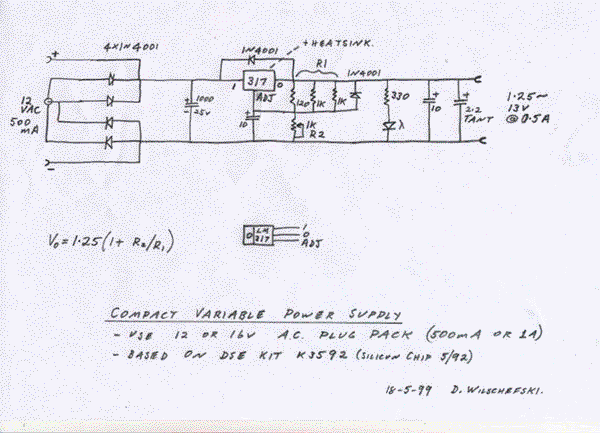
Compact Variable Power Supply


This is a handy little power supply that can provide a voltage range of 1.25 to 13 volts and current up to 500 mA. The supply, created by Don Wilschefski, is housed in a small plastic enclosure 90 x 55 x 32 mm.

Download

schematic

search term : Power Supply, Handy supply, Variable PSU, analog project (src)

Read More

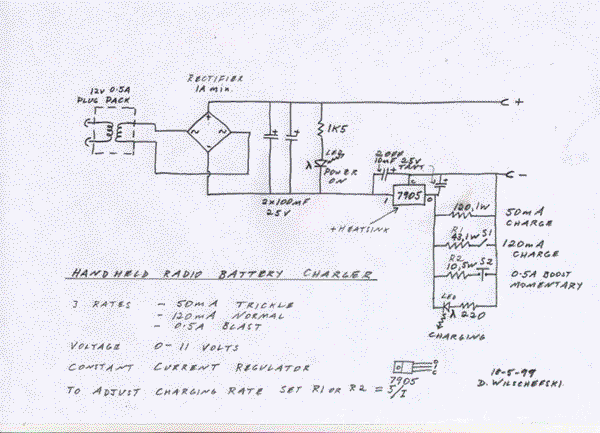
Battery Charger for Hand Held Radio

Battery Charger for Hand Held Radio
This is a handy little charger that can provide a charging current of up to 120 mA continuously for batteries in the range up to 12 volts. This project inspired by 12 volt 500 mA plug pack at an amateur auction. Two potentially useful projects resulted from this plug pack. The other is a variable power supply. The supply is housed in a small plastic enclosure 90 x 55 x 32 mm.


Download :


Schematic

search term : Battery Charger, Hand held Radio charger, Analog Project (src )

Read More

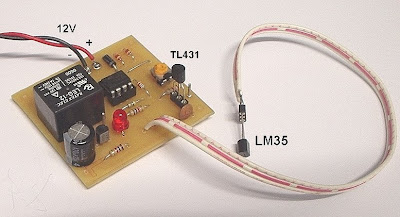
LM35 and TL431 Automatic Temperature Control

Electronic Project circuit - Automatic Temperature Control
This is an electronic circuit that can be used as automatic temperature control aapplication. The circuit switches a miniature relay ON or OFF according to the temperature detected by the one-chip temperature sensor LM35. When the LM35 detects a temperature higher than the preset level (set by VR1), the relay is actuated. When the temperature falls below the preset temperature, relay is de-energized. The circuit can be powered by any AC or DC 12V supply or battery (100mA min.)

Download : schematic, layout and PCB (pdf)

related search : Electronic circuit project, automatic application, temperauter controller, LM 35 (src)

Read More

Miniature High-Rate ESC Circuit

Electronic Analog Project - Miniature High-Rate ESC Circuit
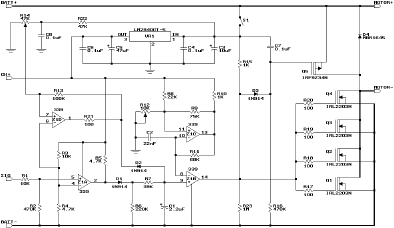
This electronic speed control (ESC) is an analog one, using off-the-shelf components. There are no microprocessors (which would require specialized equipment to program), and no surface-mount parts. It's not as small or as light as many commercially available ESCs, but it's smaller than many other do-it-yourself designs. It's also versatile, in that it can be built for many applications, ranging from small Speed 400 sport planes to "hot liner" sailplanes.

Download : schematic

tags : Electronic Analog Project, electronic speed control (src)

Read More

Buck Mode Switching Regulator

Electronic Project Circuit - Buck Mode Switching Regulator
This circuit is suitable for a variety of uses. If you have a solar powered 12 Volt lead-acid battery power source, the circuit can be used to efficiently power lower voltage devices. It can be used to provide power to devices that normally use a set of small batteries for power. Common voltages such as 1.5V, 3V, 4.5V, 6V, 7.5V, and 9V can be produced by this circuit. The circuit has been used to power small fans, portable radios, a miniature TV, and more.

Another application for this circuit is as a linear current booster (LCB). Common LCB uses include running motors and other devices directly from a solar panel with no battery. In the LCB mode of operation, it is possible to use the circuit to change a low current solar panel input to a higher current (but lower voltage) output.

Download : schematic

tags : Electronic Analog Project, Buck Switching Regulator, linear current booster (src)

Read More

Electronic Project : Precision Battery Discharger

Electronic Project : Precision Battery Discharger
This is a precision battery discharger for 8.4V 7-cell Ni-Cad or Ni-MH batteries. It's cheap, reliable discharger circuit with an easy visual indication of the battery’s state (discharging or discharged) with less than 10$ of parts. Most parts can be found around the house or taken from broken electronic equipment or purchased from Radio Shack.

The circuit as shown only works with 7-cell (8.4V) NiCd or NiMH battery packs, but with a couple additional parts it can also work with 8 cell 9.6V packs..

Download : schematic

Electronic Circuit Project, Battery Discharger, Analog circuit (src)

Read More

R/C Transmitter Range Tester

electronic circuit project - R/C Transmitter Range Tester
This project suitable for people who like with the transmitter system. It's an electronic analog project. You don't have to programming the IC to build it. The function of this electronic project is to measure the RF power being radiated from a transmitting antenna.

Among the Amateur Radio fraternity, a device such as the one described here would otherwise be known as a Field Strength Meter (FSM). Its main purpose would be to check that RF power is being radiated from a transmitting antenna. Some FSMs are tuneable across a wide range of frequencies, which allows the device to work with different transmitters and antennae - usually from HF to VHF and beyond. A difference with this unit is that it is only sensitive to those signals in the R/C section of the radio spectrum. The on-board trimmer allows you to tweak for maximum signal strength of your frequency of choice, whether it be 27MHz AM, or 40MHz FM.

In order to read the received signal strength, such a unit would ordinarily employ a mechanical analogue meter. The unit described here differs in that it uses four super-bright LEDs. The benefit of this is that it allows you to read the display from a distance - even in bright sunlight.

Download schematic(gif), PCB1, PCB2

Electronic Circuit Project, FM tranmitter, Field Strength Meter, Analog circuit (src)

Read More

Cheap Shortwave Transmitter

Cheap Shortwave Transmitter
This is a really cheap and probably illegal shortwave transmitter, don't build it. It just feeds the output from an LM386 audio amplifier directly into the power pin of a crystal oscillator can to produce AM-modulated shortwave radio frequencies. This works better than one might expect -- this particular oscillator seems to provide a stable waveform with voltages anywhere from 2.0v to 5.0v!

Cheap Shortwave Transmitter

[link]

Read More