The aim of the project is to build a lab-grade data logger with PIC18F45K20 microcontroller and a 20-bit delta-sigma converter. It's named as G5 Data Logger.

Read More
The aim of the project is to build a lab-grade data logger with PIC18F45K20 microcontroller and a 20-bit delta-sigma converter. It's named as G5 Data Logger.
Atmel has announced the maXTouch E Series of single-chip capacitive touchscreen controllers for touchscreens from 2 to 12 inches. The mXT224E, mXT384E, mXT540E and mXT768E devices offer enhanced analog sensing with a third generation capacitive touch engine and Atmel's advanced AVR® architecture optimized for capacitive sensing. Offering 224 to 768 nodes, the new series enables system designers to select the industry's most advanced single-chip solution for their touchscreen size and application.

Atmel maXTouch E Series offers enhanced analog sensing to dramatically improve performance, reduce system power and lower system costRead More
First single-chip 32-bit solutions for smartphones, e-book readers and tablets up to 12 inches
The project aim is to build a better kitchen timer. It has four independent count-up and count-down timers, display of current value of user-selected timer, start/stop and digit entry controls, and alarm buzzer.
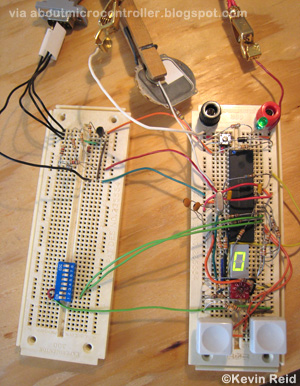
This project goal is to build a navigator that allows a user to navigate to a predefined location through the use of auditory guidance. The project is equipped with GPS, digital compass, and MCU ATmega32 to generate sound based on the direction that the user must turn in order to face the correct direction. One example implementation of this project is a self guided tours navigator.


The project goal is to build a line follower robot that can follow a dark like, on a light background. It uses an Arduino Duemillanove with the AVR ATMega 328 as main processor. For driving force the project equipped with two Parallax Futaba Continuous Rotation Servos. The robot sensor uses Pololu QTR-6A IR Reflectance Sensor Array. The system powered by 4 rechargeable NiMH Duracell AA Batteries.
 The project shows you how to build a RFID pet feeder based on Arduino and RDM630 RF-reader with a self-made circular antenna. The feeder will opens for the pet that wears a collar with an RFID tag.
 The Heater Fan Controller built around PIC12F675 microcontroller. It reads the (10k) linear potentiometer and generates appropriately timed pulses to control the DC motor running the fan. The extreme low position cuts the power entirely. This device work as a variable speed control for the heater blower in a car. The project is powered from the existing wiring and connects with just 2 wires. Or you can connect it to 12 volt device up to 10 amps.

Stimmmopped is AVR ATmega8-based project that will assists you in tuning your string instrument to a given tone. It utilizes the stroboscopic effect to give feedback about the adjustment of your instrument. When the frequency that you chose has tone then the two LEDs on the board blink. Two lines are projected at a fixed position on the string when the string vibrates with the correct frequency. If frequencies don't match, the lines appear to be blinking or moving to the observer's eye. The moving or blinking effect decreases with decreasing difference between the two frequencies.
 The AVR based RF Keypad is remote controller that emits an RF code every time you digit the correct combination on its keyboard. You can use this project to replaces remote controls based on MM53200, UM3750 and UM86409. There are three different combinations for three different actions can be entered at program-time. The keyboard layout also customizable. You can use any matrix up to 4 rows by 4 columns keyboard layout and assigning your own ASCII codes to each key.

This project aim is to reproduce the old style psychedelic lights system that was very popular in the 70s. Being in the "digital era", the technical solutions adopted are quite different from what was characterizing their predecessor system. Old style lamps have been replaced by three high power LEDs; all filters, previously implemented with analog components, have been realized with digital processing techniques; input stages have been replaced by one A/D converter and one digitally controlled variable amplifier, that is able to warranty the best signal amplitude for the system.
The project requirements are related to technologies adopted: high power LEDs need to be driven with a constant current; digital filters need a fast DSP engine, to be implemented, and an A/D converter is required to transform an audio signal in a numerical representation. Control data communications between central processing unit and external analog components require to have an SPI on board and, last but not least, the capability to link the system with a PC could be very useful for firmware debugging and for tuning some parameters in real time without needing expensive developing tools. The project is designed by Marco Signorini.

This Humidor project was designed with a Peltier module and Sensirion SHT1X series sensors. The project built to keep cigars in perfect condition by maintain preferred level of moisture and keep the temperature around 70 degrees. The core of system is based on a microcontroller ATMEGA-16 programmed with BASCOM-AVR. The application is broken into two sections the Menu system that allows configuration of the desired humidity and temperature and what units for temperature you would like to use and display. The Hardware consists of an ATMEGA-16 controller, 7 Tip120 Transistors, 1 DPDT Relay, MC78T12 Regulator, LM7805 Regulator, a few passive components, a 16*2 lcd, and a few connectors.
Tag : Humidity Project, Temperature controller, AVR project

Puzzlemation is an expandable platform of light and animation based on PIC24FJ64GA002. It can be used to create things as diverse as modular animated signs that can be changed by rearranging its tiles, to a uniquely animated puzzle. This project’s display is made of a number of tiles, about 2 inch square with an 8 x 8 array of color LED pixels. Each tile is individually powered and animated, so user can freely pick them up and re-arrange them. To set up a display, the tiles are placed in a special tray. Animations are downloaded into the tray via Ethernet and stored locally on an EEPROM, or loaded via an SD card. The tray broadcasts the animation to each of the tiles, and then synchronizes them.
John Peterson, project designer, said that the display is completely reconfigurable. If the pieces are left in the tray, the animation can be updated continuously over the Ethernet connection. If the tiles are removed from the tray, they’ll display the animation for several hours with their own re-chargeable battery power. Once the animation is synchronized and running on the tiles, user can pick them up and place them anywhere.
Download:
Project Documentation, Source Code and Schematic(zip)
tag : Display, LED, project, PIC, PIC24FJ64GA002, animation, puzzle

This small PIC based GPS logger used San Jose Navigation FV-M8 GPS module. It allow you to stores coordinates, altitude, and speed into an EEPROM. Then a Delphi based windows software converts EEPROM stored data into .kml (Google Earth format). The system equipped with MCU PIC 16F876 to control FV-M8 GPS module, EEPROM, and interfacing to PC. You can use this project for snowboarding, FPV flights, trial bike and hiking logger.
Download : .hex (16F876), Windows GPS Logger, Schematic (eagle)

This dsPIC30F4011-based servo (position) controller receives commands via a CAN. If a DC motor does not have a rotary encoder, you can plug a contactless magnetic rotary encoder (CMRE) module into the board (via two SIL connectors) and provide (in a self-contained unit) rotary encoder and position control.
Mariano Lizarraga Fernandez, the designer, explains that the board in this project also fully configurable via a CAN network and no power-cycle is necessary for any change to take effect. The board has programmed PID controllers with selectable parameter from user. The controller gains, maximum and minimum pwm commands, and device ID are also configurable. All configuration values are stored in the dsPIC's EEPROM so once it is configured at the full contempt of the end-user, no more changes are required.
Download:
Project Documentation and Schematic (zip)
 This embedded automatic timed plant feeder system can regularly feed water to your plants for a specified amount of water and also be used as an alarm clock. The project contains the several major blocks: ATmega 323 based CPU system.
To display the time and system states, it use 24x2 LCD. A speaker is used for alarming and making sounds. While push buttons used to change the system states by user. A relay is used to control the AC of the water pump with a DC signal from the processor. For feed pattern, You can setting it up any time.
Tags: Plant feeder, Automatic, MCU project src

This is an electronically-controlled dead bolt lock project based on Arduino. It use old CD player second motor that provides a nice linear motion. To use this lock the user need to type in the correct code and presses the # key to open or close the lock. The green LED indicates the door is unlocked. Red indicates locked.They keypad has 12 keys but only 10 wires. Reading the keypad is not as simple as checking to see which of the 12 switches is closed. The keys must be constantly scanned to see which if any keys are depressed. Scanning the keypad is done by multiplexing through 6 of the wires on the keypad, alternately setting them LOW and then checking the other 4 wires (blue, green, yellow, red) on the keypad to see if a button is pressed.
Watch the arduino lock in action
tag: door lock, linier motor, lock with keypad, arduino project src

The MiniTron is a high end vacuum tube stereo amplifier with efficiency, distortion, and power output enhancements provided by some unique circuitry featuring a dsPIC30F2023 controller IC. The dsPIC is used in this project to create a tracking buck converter whose output voltage tracks the audio signal. The unique SMPS resources in these IC’s do most of the "hard stuff" usually required in an SMPS design, leaving ample processing power available for other activities.
These IC’s and the Avago galvanic isolators are truly the "enabling technology" for this project. The controller IC is also used to perform system health checks, and set the operating points of the individual vacuum tubes. This allows total system programmability, offering several possible preset operating modes.
© George Anderson
Download
Project Documentation
tag : Tube Stereo Amplifier, Audio, dsPIC projec


This wireless detector project allows you to sense the presence and relative signal strength of wireless hotspots. It is "always on" and communicates the presence and signal strength of an in-range hotspot by way of sequences of pulses - like a heartbeat you can feel. The stronger and faster the "heartbeat", the stronger the wireless signal detected.
This project consists of a microcontroller PIC 12F629, some custom interface electronics, a small vibe motor, and an off-the-shelf Wi-Fi detector from D-Link. The microcontroller periodically "presses" the button on the detector to initiate a reading. The microcontroller "reads" the output from the detector indicator LEDs and uses this as the basis for pulsing out a signal on the vibe motor, which the wearer can feel.
tag : wireless networks, hotspot detector, Wi-Fi strength signal indicator src
Download this guide to learn and understanding everything you need to know about the Raspberry Pi computer, system specs, the software it runs and the amazing project based on this little PC.

PEI is the leading magazine for the global electric power generation and transmission industry. PEI provides articles on new technologies and installations and analysis.
Subscribe Fof Free!

EDN magazine provides how-to solutions for design engineers in the electronics industry. Engineers turn to EDN because they know they will always find valuable design techniques that they can use to do their jobs faster.
Subscribe Fof Free!
More Free Engineering Magazine


